A deepish dive into this topic. If you – or the people you help and support – are struggling to prioritise health and wellness, then this blog might provoke some useful thought – and potentially stimulate some action…
“Our health and wellness is so easily and commonly underprioritised…”
Our health and wellness can be so easily and very commonly underprioritised – do you agree? We often have other dominating priorities in our life – like just getting to work (or finding work or holding down a job), paying the bills, paying off debts, looking after your family, recovering from a health issue, dealing with a bereavement or simply recovering from the daily ‘grind’.
Let’s start with look at what health might mean… A perpetuating 1948 definition from the World Health Organisation (WHO, 2022) considers health as: “…a state of complete physical, mental and social wellbeing, and not merely the absence of disease or infirmity”. Huber et al. (2011) challenged this to propose that “…health is the ability to adapt and to self-manage” which indicates the more realistic demands of health maintenance.
Wellness, by contrast, may be considered more as a state of being in, or striving for, good health as an actively pursued goal. Wellness considers health as a continuum that extends from illness at one end, to a state of optimal wellbeing at the other. In seeking wellness we become proactive and preventative, and this is underpinned by self-awareness, self-responsibility and self-regulation (Stoewen, 2017).
“...health is the ability to adapt and self-manage” (Huber et al., 2011)
The Illness-Wellness Continuum was seemingly first proposed by John W. Travis MD in 1972. This continuum presents two polar extremes, which can be influenced, to varying degrees by the knowledge, attitude and behaviour of the individual. The neutral mid-point has also been described as a potential position of false wellness.
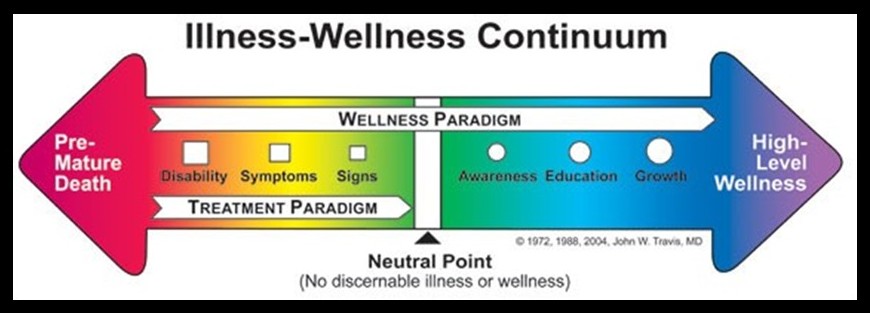
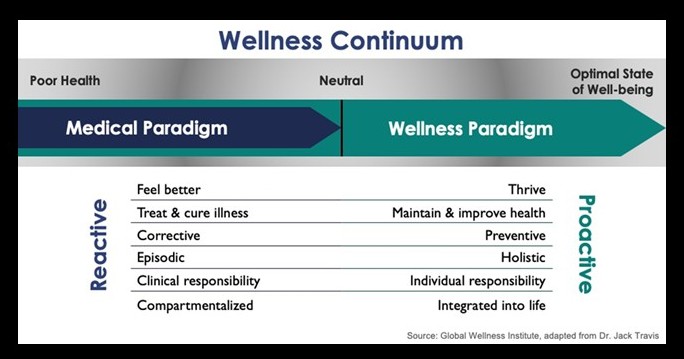
The Global Wellness Institute (2023) expanded on the work of Travis to assist improved appreciation of the contributions individual proactivity can have on health in comparison to the outdated biomedical paradigm.
The wellness concept aligns with Antonovsky’s (1985) salutogenic concept of health. Salutogenesis focuses on health rather than disease (pathogenesis), and the theory is founded on the individual developing a recognisable ‘sense of coherence’ of the comprehensible, manageable and meaningful aspects of life situations, and associated life stressors, and their perceived capability in dealing with these. In conjunction with this sense of coherence, the salutogenic concept focuses on being able to access the kinds of general resistance resources (GRR) which are likely to provide a better chance for dealing with the challenges of life (Antonovsky, 1987). Such GRR are biological, material and psychosocial, and variously include money, knowledge, experience, self-esteem, healthy behaviour, commitment, social support, cultural capital, intelligence, traditions and view of life (Lindström and Eriksson, 2006). Greimel et al. (2016) discuss how:
“A sense of coherence is developed during childhood, adolescence, and through early adulthood. It is a stable disposition of personality and a health promoting resource that improves resilience and develops a positive state of both physical and emotional well-being. The extent to which these resources are available is a major determinant in the development of a strong or weak sense of coherence.”
As wellness is multidimensional, it is helpful to understand more of its wholistic domains so that consideration can be given to each. Wickramarathne, Chun Phuoc and Albattat (2020) undertook a review on the Dimensions of Wellness and concluded that these primary physical, emotional, spiritual, social, occupational, and environmental components each intertwine to play a major role in directing humans to lead better, more productive, healthier, well-balanced social, relational and occupational lives.
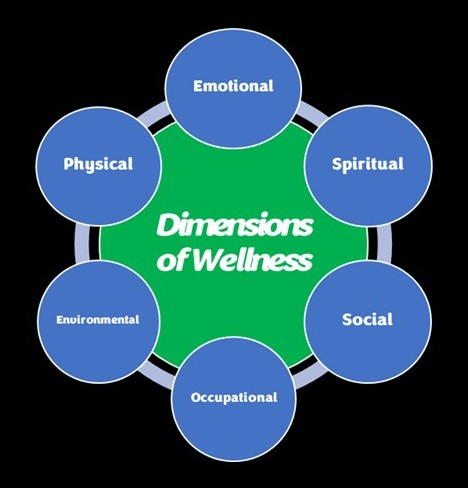
In focusing in on our health and wellness, we are recognising that in order to perform, work, study and enjoy our life, we must look after ourselves. Each of the recognisable dimensions are huge areas for personal investment, and there is never a better time to actively attend to these than the present. We all know that when tomorrow comes it is, in reality, today.
In understanding how improvements in health and wellness may best occur, we may also consider the broader determinants of health model, the original version of which was published in 1991 (Dahlgren and Whitehead, 2021). Individual determinants lie with our age, sex, ethnicity, other hereditary factors, medical history, educational history, and also our perceptions of quality of life lived. Behavioural determinants of health reflect the regular activities that characterise our lifestyle, these obviously include diet, physical activity, exercise and sport, relaxation, smoking, sex, alcohol, drugs or any other behaviours – whether these are moderately or excessively conducive or detrimental to health. The other primary determinants, which are essential to appreciate are sociocultural and environmental. These include everything from fundamental essentials (water and sanitation; safe living and working conditions; access to health care) to the affecting experiences of unemployment, discrimination and other wider societal and cultural conditions.
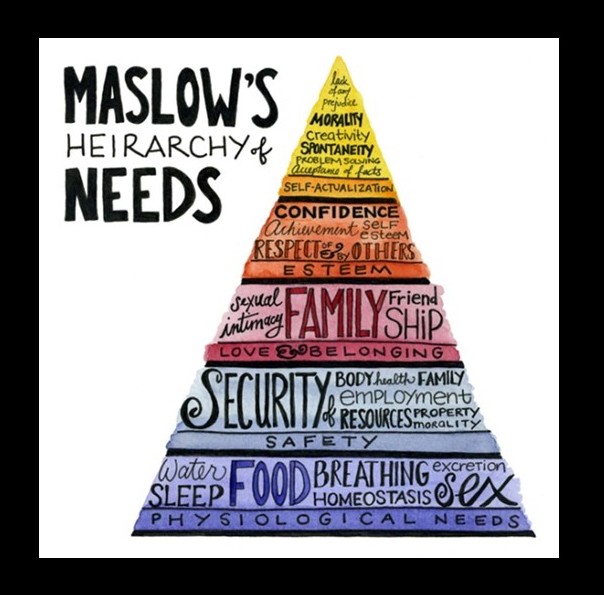
Maslow’s famous humanistic Hierarchy of Needs (Maslow, 1943), still to this day, provides context and understanding to the motivational constitutes of health and wellness (even though it is not without its validated critics). From the aforementioned foundational requirements (physiological, safety, protection and security) through to the experience of belongingness and love, self-esteem, and ultimately to Maslow’s pinnacle – self-actualisation (the realisation of true potential). Maslow (1970) himself, and 50 years later Kaufman (2020), reimagined the original hierarchy to consider a level of transcendence; for which they imply goes beyond security, growth and purpose, and allows for the ostensibly higher levels of unity and harmony within oneself and with the world. This creative and beautifully presented version of Maslow’s Hierarchy, below, is from Veronica Walsh (2014):
In a fairly recent briefing statement, The Health Foundation (Dunn, Ewbank and Alderwick, 2023) highlighted how life expectancy is stalling, and health inequalities are widening; how key risk factors are driving a significant and unequal burden of preventable ill health and premature death; how people are living for longer but with major health conditions; and how the UK health system lacks capacity compared with many other countries. These critical issues will not be resolved easily or quickly – and we can all see how unstable the evolving political climate is. Such a situation also suggests an even greater requirement for individuals (and communities) to take greater responsibility for their health.
We can all recognise factors which naturally contribute to reduced health and wellness:
- sociocultural issues (the lived experience; inequity; deprivation; access to health services; education)
- biological factors (i.e., illness; injury; pain)
- negative life experiences
- loss, grief and bereavement
- low self-esteem
- self-neglect
- anger issues
- mental health issues (e.g., anxiety; depression)
- addiction
- financial stress
- chronic stress
- discrimination (e.g., racism; sexism; transphobia; ableism; ageism; classism)
- abuse (e.g., physical; verbal; neglect; sexual; emotional; bullying)
- social isolation
- relationship issues (e.g., fall-outs; separation; divorce)
- personality disorders (e.g., paranoid; schizoid; borderline; histrionic; narcissistic; obsessive; anti-social; dependent)
- fear for personal safety or wellbeing (i.e., personal, local, national or global events)
Such listings are simplistic and inexhaustive but provide some consideration to the multitude of problems that occur and are faced by people in life. Many problems, however, are manageable and solutions – if not initially found from within – may sometimes be found through available support networks (sometimes unexpectedly). In prioritising health and wellness, the individual is strengthening their resolve, increasing their health literacy, improving their organisational ability to respond to adverse situations, and improving their coping strategies and stress reactions. Such positive developments, however small, can contribute towards reducing potential for illness, and ultimately support a life strategy which can help prepare us a little better for the multitude of challenges that undoubtedly lie ahead in life.
If we appreciate the various factors which converge to cause personal problems, we may also be in a position to alter our attitude and behaviours. Still on the theme of understanding; we could appreciate that for commencing and then sustaining positive health-related behaviour change, there needs to be a sufficiency of physical and psychological capability (C), social and physical opportunity (O), and automatic and reflective motivation (M) (the so-called COM-B framework).
The basic ingredients for personal health behaviour change include (and I am taking some influence from Farhud, 2015, amongst others, here):
- consuming a more nutritious diet (minimising over and underconsumption of foods, and reducing intake of ultra-processed foods)
- having a regular physical activity or exercise routine (minimising sedentary behaviour)
- avoiding smoking and substance abuse
- moderating (or minimising) alcohol intake
- having a good sleep routine
- avoiding unhealthy sexual behaviour
- maintaining a healthy body composition
- aiming for work-life balance
- seeking support and following medical and other advice when required
These aspects are components of personal health literacy – the knowledge and ability to make appropriate healthy decisions, and respond to health-related advice and guidance. It must be recognised that such recommendations are only feasible for those in a sufficiently secure position to be able to put them into place.
“Today is always the latest great opportunity to explore your own potential for personal regeneration”
Any time is a natural time to reflect on what has passed in life and prepare for what lies ahead. And today is always the latest great opportunity to explore your own potential for personal regeneration, and to begin creating a renewed you… In some situations, all that is required is a decision to make some change. The plans and actions for such change can be of your own conception, but can be supported by trusted friends, family and professional practitioners. We can all be agents of change – change as we all know is one of the few constants in life – hence, maybe change should be embraced for life enhancement. I believe that we should all be able to challenge our own ingrained perceptions of who we are – especially our negative thought processing and detrimental behaviours. We are all on our own personal journey – no one else is living our life. Of course, this isn’t always easy, and for many the acute life situation is simply too challenging to approach significant life change, but small steps do contribute to the longer journey. I certainly urge people to remember and consider what Huber et al. (2011) proposed “…health is the ability to adapt and to self-manage”. Life ain’t easy, and neither are the first or harder steps to adapting to and self-managing our challenges, but in so doing we build a stronger foundation and accountability for our own life.
If you would like to discuss how to begin instigating some positive change into your own life, please feel free to drop me a text or an email.
Nb. Some aspects of this article have been adapted from the learning and teaching chapter in my last book (Ward, 2024). The ebook is currently on a good offer! https://www.routledge.com/Routledge-Handbook-of-Sports-and-Exercise-Therapy/Ward/p/book/9780367714598?srsltid=AfmBOorUv-fZrMhmSrfrd_s7D4BMRjgWECgBc7y5K0G5azwJGA5IyPZv
In my next blog, I will explore concepts of exercise as medicine.
I hope you found this interesting. Stay tuned, keep well, and maybe I’ll see you later : ))
References
Antonovsky, A. (1985) Health, Stress and Coping. Jossey-Bass. London, UK
Antonovsky, A. (1987) Unravelling the Mystery of Health: How people manage stress and stay well. Jossey-Bass. San Francisco, USA
Dahlgren, G. and Whitehead, M. (2021) The Dahlgren-Whitehead model of health determinants: 30 years on and still chasing rainbows. Public Health. 199: 20-24
Dunn, P., Ewbank, L. and Alderwick, H. (2023) Nine major challenges facing health and care in England. The Health Foundation. https://www.health.org.uk/reports-and-analysis/briefings/nine-major-challenges-facing-health-and-care-in-england#lf-section-200096-anchor
Farhud, D.D. (2015) Impact of lifestyle on health. Iran J Public Health. 44(11): 1442-1444
Greimel, E., Kato, Y., Müller-Gartner, M., Salchinger, B., Roth, R. and Freidl, W. (2016) Internal and external resources as determinants of health and quality of life. PLoS ONE. 11(5): e0153232
Huber, M., Knottnerus, J.A., Green, L., Horst, H.vd., Jadad, A.R., Kromhout, D. et al. (2011) How should we define health? BMJ. 343: d4163
Kaufman, S.B. (2020) Transcend: The New Science of Self-Actualization. TarcherPerigee. New York, USA
Lindström, B. and Eriksson, M. (2006) Contextualizing salutogenesis and Antonovsky in public health development. Health Promotion International. 21(3): 238-244
Maslow, A.H. (1943) A theory of human motivation. Psychological Review. 50(4): 37096
Maslow, A. H. (1970) Religions, values, and peak experiences. Penguin. New York, USA
Stoewen, D.L. (2017) Dimensions of wellness: Change your habits, change your life. Can Vet J. 58(8): 861-862
Ward, K. (2024) Learning in sports and exercise therapy. In Ward, K. (ed) Handbook of Sports and Exercise Therapy 2nd ed. Routledge. Oxon., UK
WHO (World Health Organisation) (2022) Constitution. Available at https://www.who.int/about/governance/constitution Accessed August 2023
Wickramarathne, P.D.V., Chun Phuoc, J. and Albattat, A.R.S. (2020) A review of wellness dimension models: For the advancement of the society. European Journal of Social Sciences Studies. 5(1): 185-198
© Copyright Keith Ward 2025